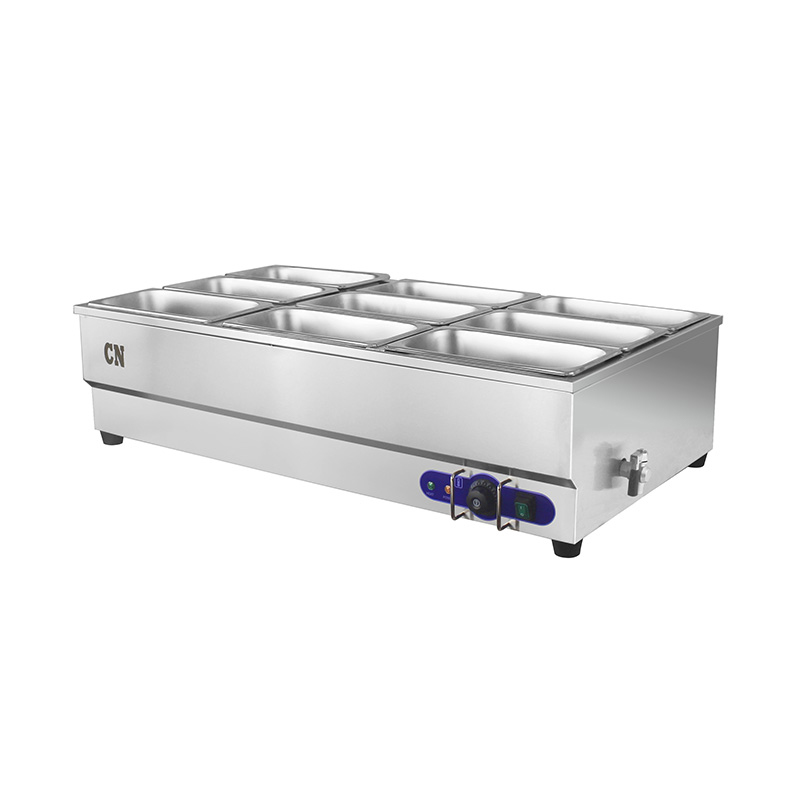
Modern commercial kitchens often rely on both a Stainless Steel Commercial Kitchen Countertop Griddle and a Stainless Steel Commercial Electric Bain Marie to handle different stages of food preparation and service. While the griddle focuses on high-temperature grilling and frying, the electric bain marie is designed to maintain consistent heat for prepared dishes, soups, sauces, and side items. Stable heating is not simply a convenience in catering environments; it directly affects food texture, taste consistency, service rhythm, and kitchen workflow. Understanding how a stainless steel commercial electric bain marie maintains steady heat helps operators make informed purchasing and usage decisions.

In restaurants, canteens, snack bars, and buffet lines, food must remain at a safe and controlled temperature for extended periods. Uneven heating can result in soups cooling too quickly or sauces overheating at the edges. Both situations affect food quality and may create waste.
Unlike direct-fire equipment, an electric bain marie uses indirect heating through a water bath system or controlled heating plate. This structure allows gradual heat transfer, reducing sudden temperature spikes. The result is a steady holding environment that supports:
Stable heat control is particularly important for foods such as cream-based soups, stews, gravies, and porridge, which can easily separate or burn if exposed to uneven heat.
A Stainless Steel Commercial Electric Bain Marie typically includes integrated electric heating elements located beneath the water tank or heating chamber. Once powered on, the system gradually warms the water or base surface to the preset temperature. The thermostat continuously monitors and adjusts the heat output.
This mechanism differs from open-flame heating in several ways:
Many commercial models allow temperature adjustment from room temperature up to approximately 300°C for certain configurations, although food holding applications usually operate at lower ranges appropriate for safe service. The precise control prevents excessive boiling or rapid cooling, which helps maintain texture and moisture.
Because the heating does not rely on gas combustion, installation is relatively straightforward. Operators only need access to a stable power supply, which simplifies layout planning in commercial kitchens.
Indirect heating is one of the core reasons a stainless steel electric bain marie ensures stable performance. Instead of exposing food containers to direct flame or concentrated heating coils, the system transfers warmth through a controlled medium, typically water.
This design offers several practical advantages:
For buffet service, this consistency means customers receive dishes at a uniform temperature throughout service time. For kitchen staff, it reduces the need to stir or monitor every container frequently.
In operations where multiple dishes are served simultaneously, separate compartments allow independent temperature settings. This flexibility supports varied menu structures without compromising stability.
The use of food-grade stainless steel plays a significant role in stable heating. Stainless steel offers balanced thermal conductivity and structural strength. In a commercial electric bain marie, the stainless steel body helps maintain internal temperature by reducing unnecessary heat loss.
Key structural features include:
These features help retain heat and reduce energy consumption during long operating hours. Because the interior surface is smooth, cleaning is also easier, which contributes indirectly to consistent performance. Accumulated residue can affect heat distribution, so easy maintenance supports stable operation over time.
Removable food pans further simplify cleaning. Staff can remove containers for washing without disturbing the heating system.
Stable heating is closely connected to food safety standards. Commercial kitchens must maintain holding temperatures that prevent bacterial growth without damaging food structure. A stainless steel commercial electric bain marie provides adjustable temperature control through mechanical knobs or digital systems.
The thermostat ensures that:
Precise control reduces the need to add water frequently for heat retention. When the temperature is stable, evaporation remains manageable, and kitchen staff can focus on service efficiency rather than constant monitoring.
In contrast, inconsistent heating systems often require manual correction, which increases labor demands and the likelihood of human error.