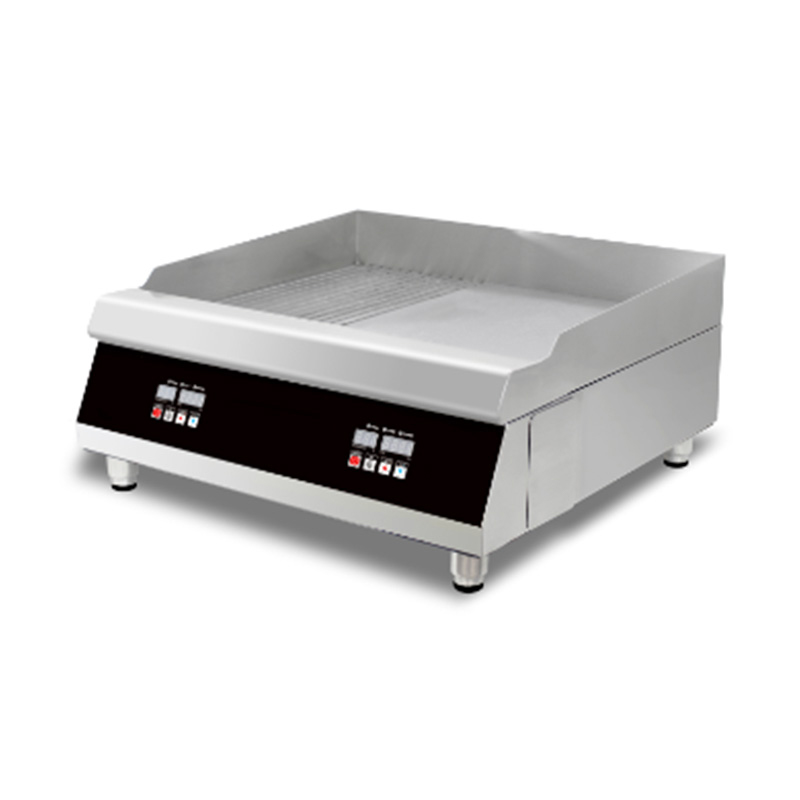






A stainless steel commercial kitchen countertop griddle is bought for the breakfast rush and the lunch service, and it is judged on whether the plate holds heat when food lands on it. Buyers usually compare plate size, burner count, and price, while the differences that decide whether the griddle performs sit in plate thickness, how evenly heat spreads across the surface, and how the front edge and grease trough behave when the plate is loaded. A griddle that heats quickly when empty can still develop cool spots once six portions are cooking at once, and those cool spots are what turn a fast service into a slow one.

The cooking plate stores heat, and the amount it stores depends on thickness and material. Two points deserve attention:
Buyers should ask about plate thickness, the material grade, and how the plate is machined or polished, since surface flatness affects both contact with food and how easily the plate cleans. A plate that is flat but too thin will still develop cool spots under load, and no amount of burner power will fix that.
The burners sit under the plate, and their layout decides whether heat spreads evenly. Buyers should ask how many burners there are, how they are spaced, and whether each is independently controlled. Independent control lets the operator use one section while another recovers, which matters when the menu mixes items that cook at different temperatures. A Stainless Steel Commercial Kitchen Countertop Griddle with a single control across the whole plate is simpler but less flexible during a mixed service, and the operator ends up moving food around to find the right heat.
The front edge and grease trough are small features that decide how the griddle behaves in a working kitchen. A raised front edge keeps food and oil on the plate, while a sloped trough directs grease toward the drain. Buyers should ask how the trough is shaped, where the drain sits, and how the plate is cleaned around the edges. A plate with sharp internal corners collects carbonized grease that is difficult to remove, and a trough that does not slope properly leaves standing oil that smokes during the next service.
The cabinet and legs carry the weight of a thick steel plate, and stability matters when the operator presses on the plate with a spatula. Buyers should check how the cabinet is constructed, whether the legs are adjustable, and how the unit sits on an uneven floor. A griddle that rocks when pressed transfers stress to the gas connections and the plate seams, and a unit that is not level cooks unevenly because oil pools at one side.
Rather than comparing plate size and burner count, buyers can ask about plate thickness and material, burner layout and independent control, trough slope and drain position, and cabinet construction. They can also ask how the plate performs under a full load, since a demonstration with an empty plate says little about a Saturday morning. Suppliers who answer with measurements and test conditions are easier to trust than those who answer with a capacity figure. The griddle is a familiar appliance; the difference lies in whether plate thickness and heat distribution were matched to the menu it will serve.