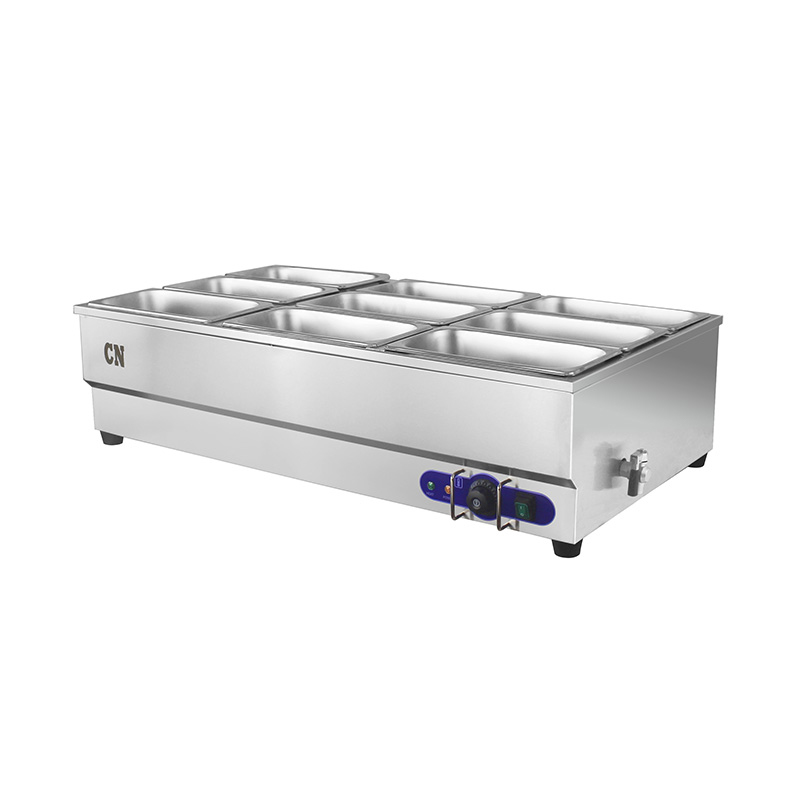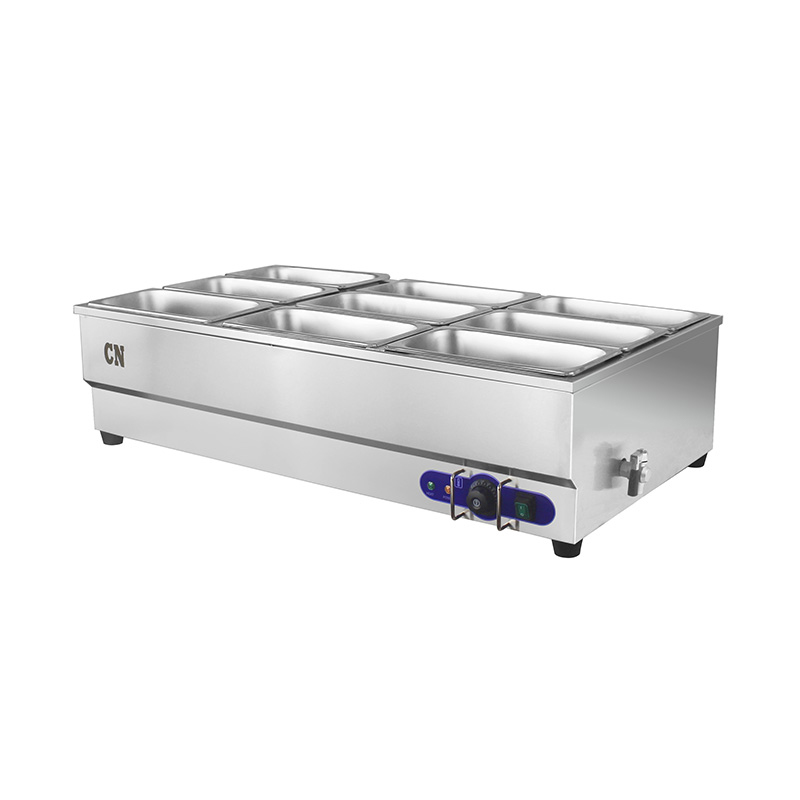






A stainless steel commercial electric bain marie is bought to keep food at serving temperature through a long service, and it is judged on whether the food looks and tastes the same at the end of the shift as it did at the start. Buyers usually compare pan capacity, wattage, and price, while the differences that decide whether the unit performs sit in how the water bath is heated and controlled, how evenly the heat reaches the pans, and how the unit behaves when pans are removed and replaced during service.

A stainless steel commercial electric bain marie heats food indirectly through water, and the water temperature is what actually holds the food. The thermostat should control water temperature rather than air or surface temperature, since a sensor in the wrong place lets the water overheat or lag. The heating element should be positioned so that it does not create a hot spot directly under one pan, because uneven water temperature shows up as food drying at one end of the unit. Buyers should ask where the temperature sensor sits, how the element is distributed, and how the unit behaves when a pan is removed and the water level drops.
A bain marie usually holds several pans, and the food in each should be at the same temperature. Buyers should ask how the water circulates, whether the unit relies on convection alone or uses a pump, and how the pan wells are arranged. A unit with poor circulation develops warm and cool zones, and the operator ends up moving pans around to compensate. Checking temperature at several points across the bath is more useful than checking one pan.
Water evaporates during service, and a bain marie that runs dry overheats and can damage the element. Buyers should ask how the water level is monitored, whether there is a low-water cutout, and how the unit is refilled during service. A unit that requires the operator to lift pans to refill is awkward during a rush, and one without a cutout is a safety concern. Drain taps and overflow features also affect how easily the unit is maintained.
The stainless steel grade, the insulation, and the way the unit is assembled affect both heat retention and cleaning. Buyers should confirm several things before ordering:
A well-insulated unit holds temperature with less energy, and a unit with accessible drains and smooth corners is easier to keep hygienic.
Rather than comparing pan capacity and wattage, buyers can ask where the temperature sensor sits, how water circulates, how the water level is monitored, and how the unit is insulated and cleaned. They can also ask how the unit performs with pans removed and replaced, since that is what happens throughout a service. Suppliers who answer with test conditions and construction detail are easier to trust than those who answer with a capacity figure. The bain marie is a familiar appliance; the difference lies in whether the water bath was designed to hold food steadily rather than simply to heat it.